
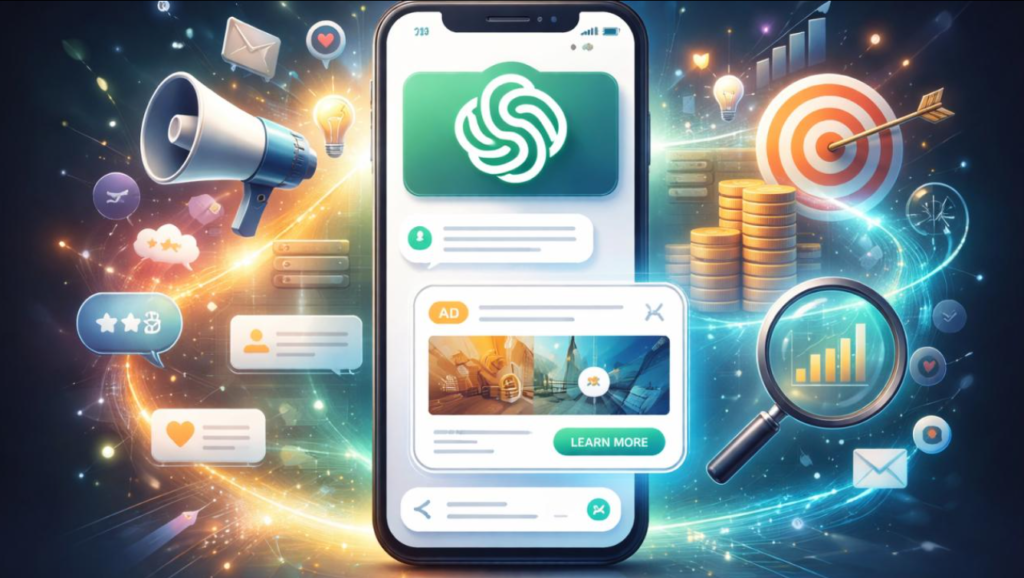
ChatGPT Ads: A New Way for Businesses to Reach Customers
Digital advertising is changing quickly, and businesses now have another platform to consider: ChatGPT. OpenAI has introduced ChatGPT Ads, giving businesses the opportunity to advertise within the ChatGPT experience. Through the new Ads Manager Beta, advertisers can create campaigns, set budgets and targeting, upload ad creatives, launch campaigns, and monitor performance. What makes this exciting is that ChatGPT is not a traditional search engine or social media platform. People use it to ask questions, explore ideas, compare options, research products, and solve problems. This creates a different environment for advertising—one that is based more on conversation and user intent. How Can Businesses Create Ads on ChatGPT? Creating a ChatGPT advertising campaign starts with OpenAI Ads Manager Beta. Businesses first need to set up their advertiser account, add billing information, complete verification, and then create their campaign. The campaign structure is similar to other major advertising platforms, but it has some unique elements. A campaign contains the overall objective, budget, dates, and targeting. Inside it, advertisers can create ad groups based on particular themes or intents. Ads can then be added to each ad group with a title, copy, image, and landing page. Businesses can choose different campaign objectives depending on their goals. These can include CPM for reach and awareness, CPC for clicks and traffic, and conversion-optimized CPC for driving specific actions after a click. Advertisers also have the option to create multiple creative variations. Instead of relying on one advertisement, businesses can provide different titles, descriptions, and creative angles. This gives the system more opportunities to find situations where an advertisement is relevant to the user’s needs. For example, a digital marketing agency could advertise when someone is exploring topics related to improving their online presence, growing a business, or attracting more customers. The goal is to make the advertisement useful and relevant to the conversation rather than simply showing a generic promotional message. Why Are ChatGPT Ads Different from Traditional Ads? The biggest difference is how relevance is determined. Traditional advertising platforms often rely heavily on keywords, searches, demographics, interests, or browsing behaviour. ChatGPT Ads are designed around a more conversational environment, where factors such as conversational intent and relevance can help determine when an advertisement may be useful. Imagine someone asking ChatGPT, “How can I get more customers for my small business?” Instead of seeing an advertisement completely unrelated to that question, the ChatGPT advertising experience can provide an opportunity for a relevant business or service to appear alongside the conversation. This makes ChatGPT Ads particularly interesting for businesses that offer solutions to specific problems. The focus moves beyond simply getting an impression and toward reaching people when they are actively exploring a need. Another important difference is privacy. OpenAI says advertisers do not receive users’ conversations or personal details, and ads are kept separate from ChatGPT’s answers. This is designed to allow advertising while maintaining a clear distinction between paid content and the assistant’s responses. ChatGPT Ads are still a developing advertising platform, and availability is being expanded gradually. However, they represent an important new direction in digital marketing. As more people use AI assistants for research, recommendations, and decision-making, businesses may increasingly look for ways to reach potential customers within these conversations. For digital marketers, this is more than just another advertising platform. It is a sign that the future of online advertising may become increasingly intent-driven, conversational, and AI-powered.
ChatGPT Ads: A New Way for Businesses to Reach Customers Read More »